


Researching design framework for dynamic, flexible and inclusive workspace experience

ROLE: Research, Design
TEAM: Lucy Yu, William Qian
CLIENT: Self-Directed Research
YEAR: March 2021
How Might We Transform Workplace Experience for Dynamic, Flexible and Inclusive Office User Experiences?

1. Why
The pandemic accelerated the process of work-life integration. Instead of being independently exclusive, our work and personal lives have become interwoven. This lifestyle transformation inevitably introduces new inquiries such as "where we work, how do we work, and whom do we work with? "
Quality workspace leads to less stress and a productive atmosphere. In fact, studies in cognitive psychology and neuroscience show that human cognition depends not only on how the brain processes signals but also on the environment in which those signals are received.
While this project started as a brief competition proposal, Lucy and I continued our research and exploration.
As designers, we wanted to ask the question,
"How might we reimagine and design a future workspace that is dynamic, flexible, and inclusive?"





2. Contextual Inquiries and Office User Personas
To begin our research, we first focused existing insights from credible design/consulting agencies. Our initial secondary research informed us of several common themes such as hybrid working, digital connectivity, work-life flexibility, and personal wellbeing.
While we did not have the opportunities to conduct in-person 1:1 interviews, we were able to gather personal accounts from online forums that had given us contextual understandings and qualitative data on the subject of remote/hybrid working.
Using those insights, we were able to produce 4 types of office user prosonas.

(Click to magnify)


3. User Enactment and Journey
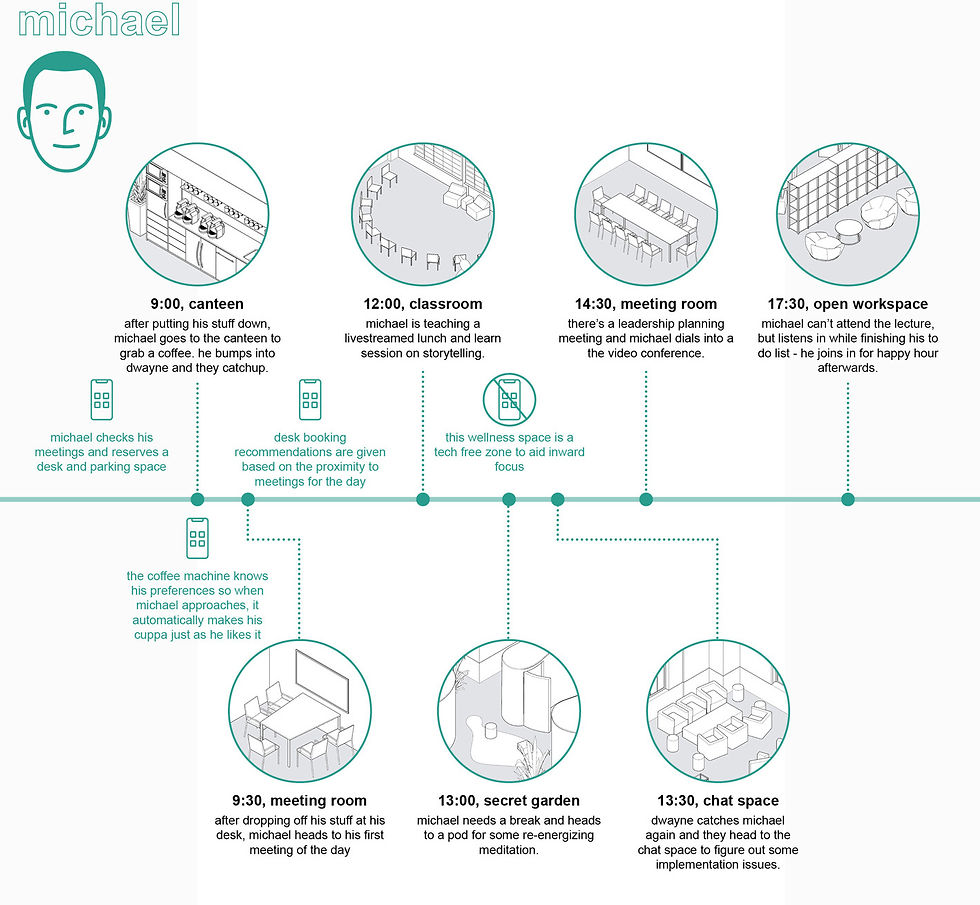
In addition to producing descriptive user personas, we also utilized user-enactment methods and put ourselves into each perspective persona's shoes. We were able to simulate their daily experience and behaviors as hybrid workers.
The results allowed us to better understand their potential professional, spatial, and functional needs as they go through their daily motions.


4. Research Informed Office Design (a kit of parts)
Equipped with our research generated insights and architectural/technical experiences. Lucy and I identified 4 important attributes for future workspaces and designed a collection of spatial systems that can facilitate dynamic working environments. In the future, the workspace would likely prioritize functional flexibility and organizational fluidity in contrast to today's workplace organization which can be structural and rigid.
The following spatial kit of parts can together facilitate a responsive working environment that can help future "employees" to simultaneously fulfill their personal and professional needs. In addition, we also ideated a functional, also modular set-up for complete work from home scenarios.


5. Designing the Functional Backend
A responsive environment needs a responsive system to support its operations.
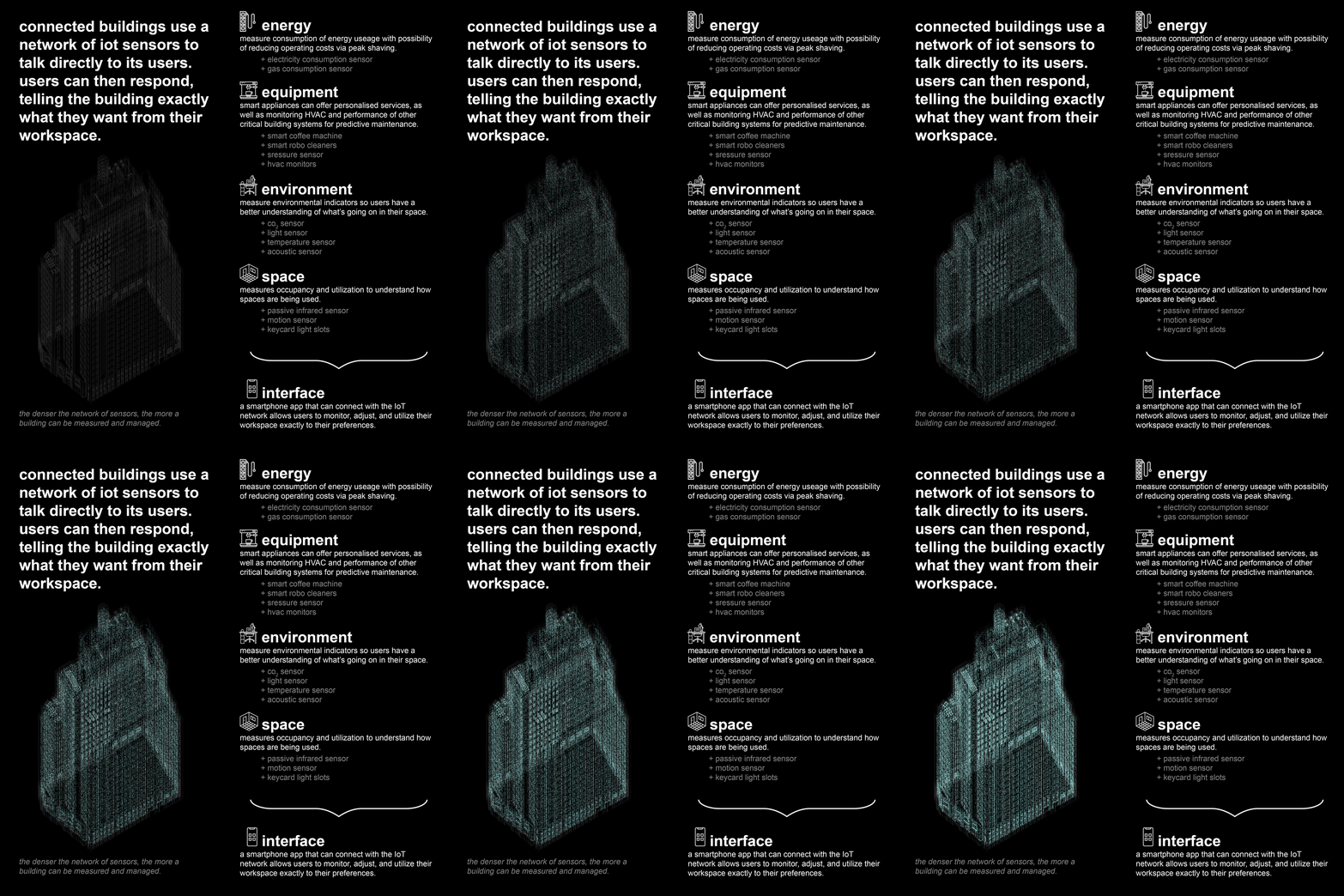
In addition to designing spatial configurations, we also designed a framework that integrates an intelligent building system with the space itself. One problem with the existing building design is that rarely do designers consider technology, data, and information architecture as a part of the design opportunities. (or constraints) As a result, "smart building solutions" are often implemented as an afterthought.
We want to take an alternative, a modular approach that allows us to consider both physical and digital design. As we future refine the environment, we also strategically designed an IoT network that collects aggregate data for future workplace optimizations.

6. Data-Driven Understanding and Human-Building Interactions
The advantage of designing at the intersection of digital and physical environments is that designers can utilize additional data to understand and potentially improve the environments. One major challenge for pure physical design is that beyond timeline execution, overhead-profit ratio, and quality assurance, designers don't have the means to measure the design impact.
However, by combining digital infrastructure within the physical design, both users and designers can evaluate both the qualitative and quantitative impact of the space. We identified several types of data that we can use as future KPIs.


7. Proposal: Workplace Transformations
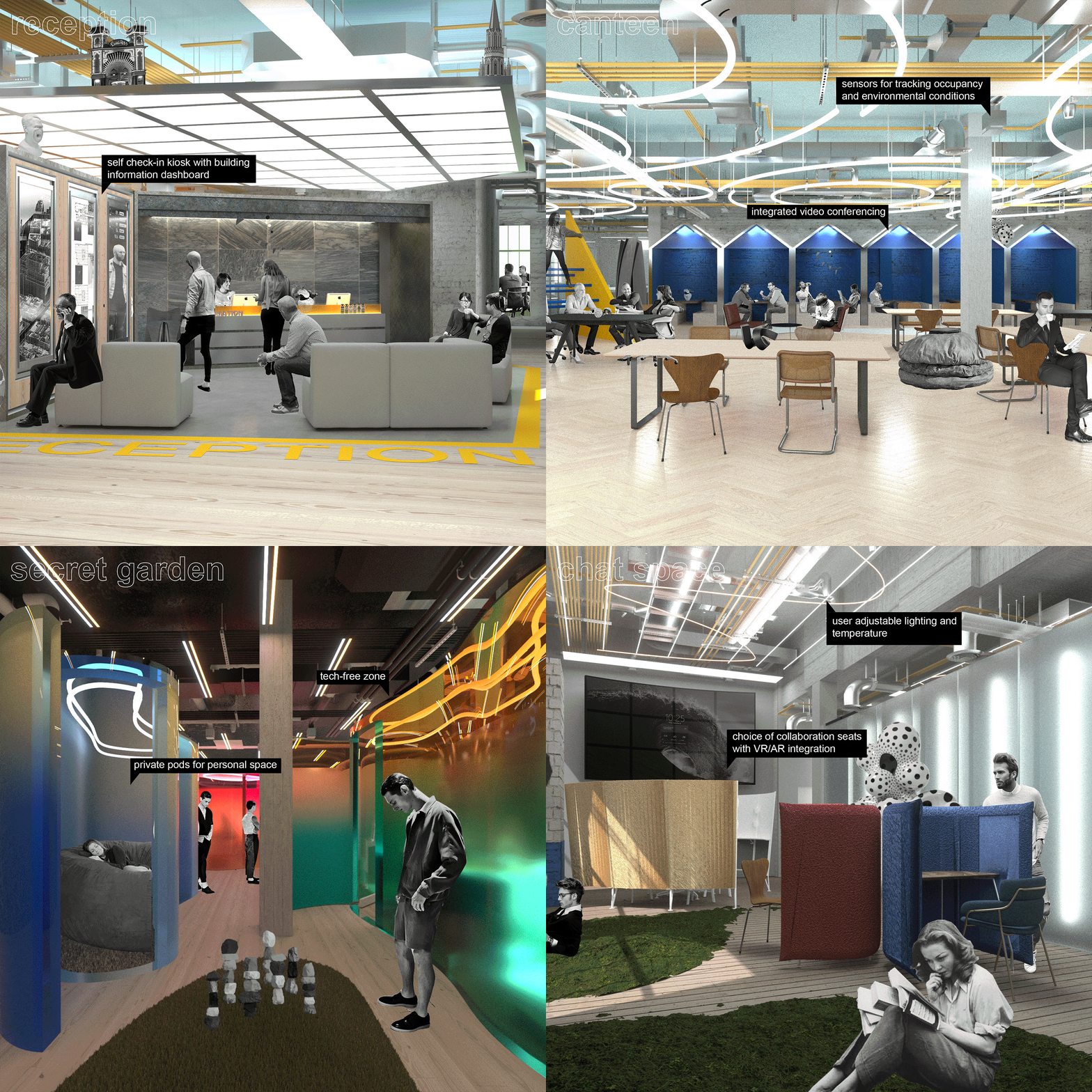
The future of work experience is driven by one's own choice. As organizations across the world start to embrace alternative working styles, our workplaces will also transform from spaces of task performance to spaces for anchoring, growth, and wellness.
Future workplaces can give you a table for work, but it can also generate long-term usage insights. By providing both physical and digital touchpoints, the environment will allow users to understand how can they best improve the environment for future organizational changes.

FLUID OFFICE-HOME EXPERIENCE

8. Outcome and Reflections
It always feels nice to be able to go on a rabbit chase for things that we are passionate about. Overall, this has been a great experience for practicing design research and storytelling.
Surprisingly, insights generated from this project actually informed some real transformation strategy for certain corporation ($14.2 billion valuation also why this project is password locked). While I was not involved with that part of the story, it is nice to know that this project turned out to be "more than just a personal design practice."
If I had more time and resources, I wish to recruit real participants and conduct feedback diary studies as this research method can allow me to accurately identify challenges with existing work-life styles and make more grounded interactions.
That's all for now. Thank you for your time.