
Reconnecting an urban landmark with the next generational users through IoT enabled interactions and cross-medium service design


ROLE: Design Lead
TEAM: CIVIS LLC
CLIENT: The Citty of ChangSha
YEAR: March 2021
Design Brief
Client Requirements
In the March of 2021, the team was invited to participate in a commissioned high-profile urban renovation project in Chang Sha, China, the provincial capital city of Hunan Province. The client was the local prefecture city government and wanted creative proposals that:
-
Promotes local culture and highlight the famous nightlife activity of Chang Sha
-
Helps to fortify the culture of personal fitness and innovative personal health care
-
Helps to reconnect the public urban landscape with the younger generations
-
Increases attractiveness on social media and likeliness to be featured by KPI (key point/person of interest)
Demographic Research and Hypothesis

To begin with, we would like to find out who will be interacting with our design. Our first preliminary research subject was the age distribution among Chang Sha residents.
We sampled the recent census data and it showed that Chang Sha is a relatively young city and it is safe to assume that more than 90% of the above 15 yr and below 70 yr demographic in the region has internet-enabled smartphone devices.

Another helpful piece of data that I came across was a survey research (n=1323) regarding wearable tech ownership in China published by Rakuten Insight. According to the published data, 30% of the population of age up until 45 years old own a smartwatch (even the most basic model comes with basic fitness tracking features). Back in 2015, only 10% of 16-24 years old own smartwatches, personal wearable tech is a consistently growing trend with a long-term practical, cultural significance.
On a consumers' behavior level, the increasing ownership of wearable tech indicates that a large proportion of the current Chang Sha population might embrace interactive, immersive experiences curated by innovative, integrated service design.
This finding led us to the following five hypotheses that we would like to investigate during our onsite visits:
-
Users can depend on their internet connectivity and smartphone devices for daily functions.
-
Social media exposure and feedback can be effective behavioral motivation factors among the younger age brackets (<56)
-
It is also the same range of users who are health conscious and very aware of body-image
-
Performance, identity, and unique experience are considered as a core part of their personal happiness.
-
Accessibility to interactive feedback (Heart rate, Blood Oxygen level, Pedometer, etc.) associated with performance metrics is still attractive to those who embrace a relatively passive lifestyle.
Can we maximize the value of urban public space by combining physical space and digital interactions?
Current Site Photos


Our first site visit showed the team that the park is very underutilized. Even though it is situated at one of the busiest intersections at the city center, it does not appear to attract any pedestrians' attention. Only a few nearby residents are sitting on the bench. We generated a list of existing challenges and opportunities:
-
Challenges (-)
-
Outdated: The current design is outdated and does not attract attention from younger citizens.
-
No TouchPoints: Other than the park paths and benches, there are touchpoints for interactions.
-
Cultural Misalignment: Overall, the park does not align with the lifestyles of the younger generations who are becoming increasingly active outdoor.
-
Opportunities (+)
-
Connectivity: The site itself is very well positioned right above a major subway station
-
Crowd Exposure: There are plenty of residential buildings in the proximity meaning the site is already well exposed
-
City Culture: Chang Sha already has an established culture of outdoor activities and after-work nightlife.
What Do You Think?
Onsite Ambush Comparative Survey (A/B)

Set-Up
To understand everyday citizens' attitudes towards public space function, aesthetics, and technology, I created a comparative collage that contains two sets of urban space references:
-
Blue (Group A): Permanent interactive public architectural designs featuring interactive lighting assemblies and some pavilions allow the visitors to influence the lighting conditions through kinetic inputs
-
Red (Group B): Permanent architectural designs that focused on physical form design and some with physical interaction touchpoints such as swing, ping pong table, and other exercise equipment
The on-site team member attempted to obtain a one-sentence qualitative comment from pedestrians willing to answer the inquiry.
Feedbacks
The qualitative feedback from the collection of short surveys indicates that the younger generation prefers group A more for landmark designs that activate the environment, interact with users, and increase social-media attractions. I was very encouraged by this feedback because it supports our design philosophy which combines integrated interactive service design with architectural design.
Physical Parks
Playgrounds
Urban infrastructures
Users
Citizens
Tourists
Smart
Devices
Disconnected
There is a missing link between our interactions with the urban space and our devices. Because of the lack of embedded connective technologies, urban parks and playgrounds have regressed to concrete surfaces that we simply disregard. This problem continues to exacerbate the lack of public activities and eventually leads to abandonment, property auctions, and gentrifications.
But What If...
I proposed a solution with much more integrated relationship between the citizens, recreational infrastructures, and personal devices. Instead of the existing fragmented experience, Our design engaged the problem by embedding interactivity within the recreational equipment and providing digital access to the citizens, hence providing a more integrated experience.
Physical Parks
Playgrounds
Urban infrastructures
Users
Citizens
Tourists
Smart
Devices
Digital Interfacing
-
Activity Log
-
Event Participation
-
Landscape Activations
Public Activities
-
Excercise
-
Media Festival
-
Public Announcement
Interactive Landscape
-
Lighting Control
-
Media Projection
-
Interactive Hub

A Hybrid Service Design Framework
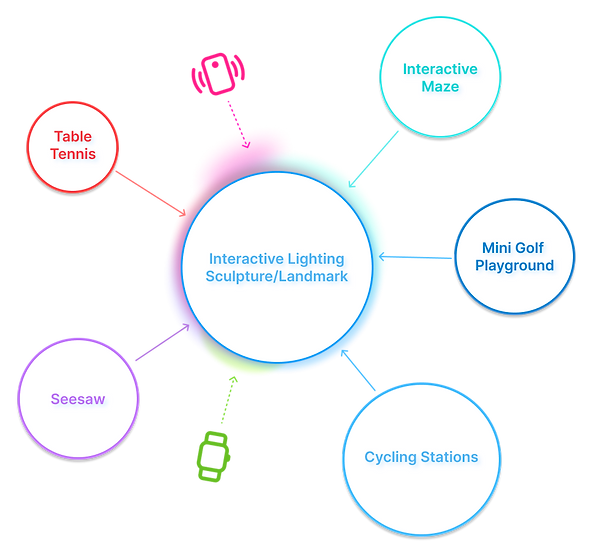
Encouraged by the accumulated insights, I proposed a service design network that can be fully integrated into the landscape and architectural designs. The central node will be a lighting pavilion capable of multiple-zone projections mapping. Its functions include:
-
Reflect site activity
-
Indicate activity level
-
Connect with personal devices through public domain
Physical Parks
Playgrounds
Urban infrastructures
Users
Citizens
Tourists
Smart
Devices
Challenge
There is a missing link between our interactions with the urban space and our devices. Because of the lack of embedded connective technologies, urban parks and playgrounds have regressed to concrete surfaces that we simply disregard. This problem continues to exacerbate the lack of public activities and eventually leads to abandonment, property auctions, and gentrifications.
Summary
Before

After

Design Interventions
Energy from Activities
The presence of people is the life of a city. At the center of the park is an outdoor led installation. The tree-shaped lighting sculpture is connected with sensors strategically installed throughout the park. As the citizens utilize the public fitness facilities, they will be surprised that the tree would shine with similar intensity and color.




Calories as Tokens
Promoting daily fitness awareness is another central design motivation for the origin park. Using a publicly available portal, the users can deposit daily calorie expanded to light up the installation or trigger special sequences during festival occasions. The center installation becomes a platform to manifest public energy and urban vitality.

* Diagram is illustrating a user using their daily calories burnt as tokens to activate the LED lighting in the park.
